
We would like to express our profound gratitude to the Civil Liberties Union for Europe for their invaluable support. The project titled Digitalisation Delayed, Justice Denied? was made possible through the CERV STRIVE 2025 grant initiative, which is financed by the European Union.
You can find more details about the project and its outputs here.
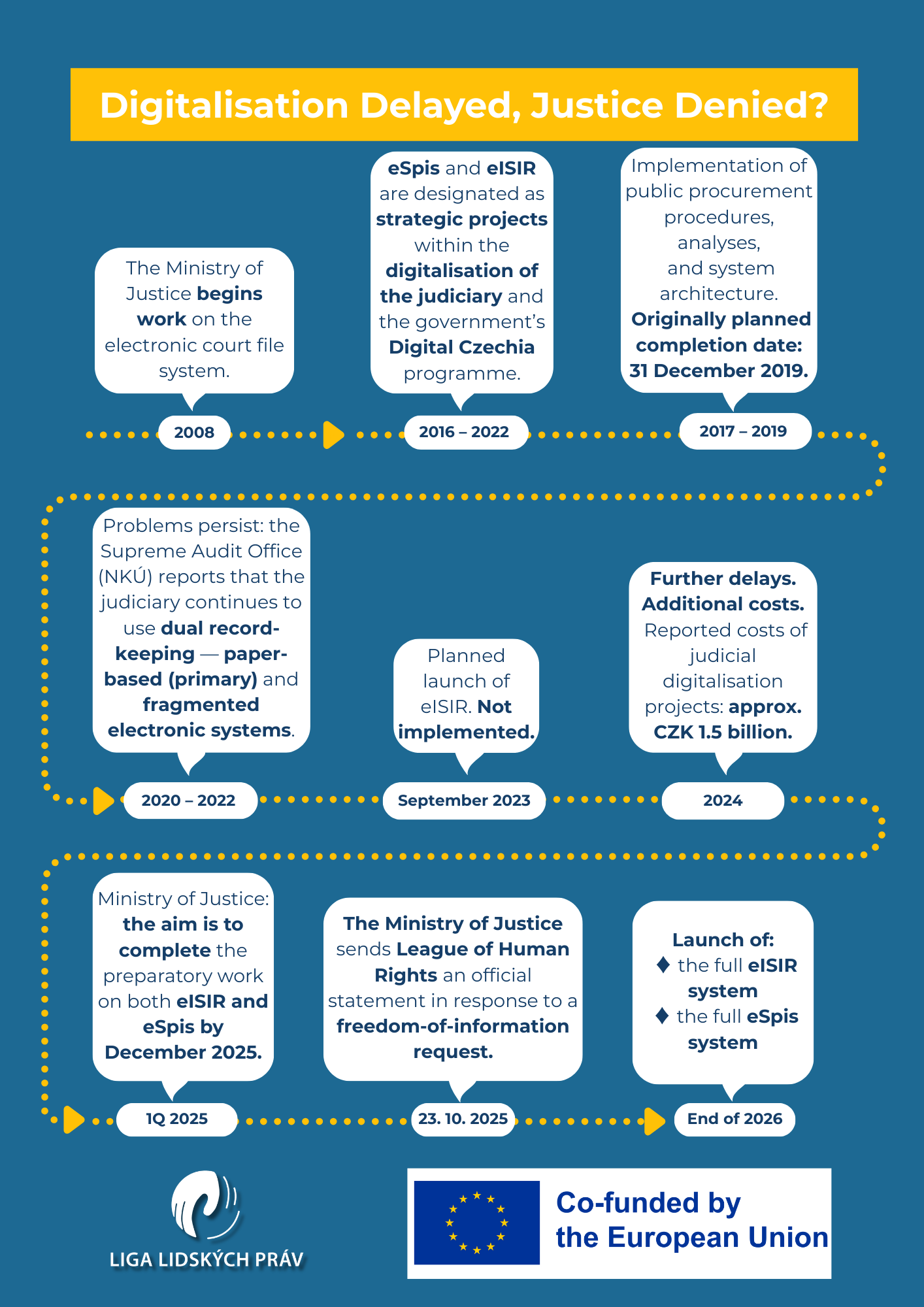
The digitalisation of the court system has been a topic in the Czech Republic for the past twenty years, yet real progress remains rather gradual and fragmented. According to the analysis published by League of Human Rights in 2025, the Czech judiciary despite certain partial reforms, still faces significant challenges in fully meeting European standards and addressing structural issues that could contribute to the effective functioning of eJustice. [1]
- The digital framework exists, but practice lags behind
In recent years, the Czech Republic has adopted several legislative measures intended to support digitalisation — in particular the Act on the Right to Digital Services, the reformed approach to the publication of judicial decisions, and updated strategic documents of the Ministry of Justice. While these steps signify essential prerequisites, they have yet to manifest into tangible, functioning tools. [2]
A fundamental deficiency remains the absence of a fully functioning electronic court file (the so-called eSpis). Although its development has been underway since 2008, the project has been systematically delayed and its implementation repeatedly postponed. The projected launch date is currently set for 2026. [3] The absence of an electronic court file system precludes the possibility of comprehensive digitalization of other judicial processes, including remote access to files, automated service of documents, and the effective utilization of artificial intelligence.
At the same time, the justice sector’s ICT infrastructure is fragmented, technologically outdated, and hinders interoperability across systems [4]. Despite formal strategic commitments, the Czech judiciary thus remains dependent on paper files and manual procedures.
- Delays in digitalisation prolong proceedings and hinder access to justice
The delays in digitalisation demonstrate tangible impacts on parties to proceedings. In practice, we encounter situations in which physical access to the court file is the only realistically available option — leading to time losses, increased costs, and unnecessary delays. The absence of remote access places limitations also on legal representatives, who are required to travel for every procedural act and find it difficult to effectively manage multiple cases at once [5].
The use of electronic submissions similarly presents its own set of challenges. Although procedural rules allow documents to be filed electronically, the relevant provisions are often interpreted in a formalistic and inconsistent manner. In certain instances, an electronic submission has to be subsequently supplemented by a paper original, which significantly undermines the advantages of digitalisation. [6]
The prospect of remote hearings — which could potentially further increase access to justice — is encumbered by both legal and technical limitations. The identity of participants cannot be verified via eID, and thus the presence of a court employee is always required, limiting the feasibility of remote hearings. [7]
- Publication of decisions has improved, but remains inconsistent and uneven in quality
Introducing the obligation to publish decisions of all courts is undeniably a positive step. However, practice shows significant differences between individual courts — both in the scope of published decisions and in the quality of anonymisation. [8] A unified methodology is lacking, which would ensure consistent data protection and uniformity of published information.
The online system for court decisions is also fragmented: some databases are operated by individual courts, others by the Ministry of Justice. The latter poses challenges to effective searchability and overall orientation of the public and professionals when navigating online jurisprudence databases.
- European obligations increase the pressure for rapid modernisation
The situation is further shaped by the European legal framework. The most significant framework is the Regulation (EU) 2023/2844 of the European Parliament and of the Council of 13 December 2023 on the digitalisation of judicial cooperation and access to justice in cross-border civil, commercial and criminal matters, and amending certain acts in the field of judicial cooperation. [9] The latter explicitly obliges Member States to digitalise cross-border proceedings, use the European e-CODEX interface, introduce interoperable videoconferencing, and ensure electronic service of documents.
The utilisation of artificial intelligence will also be significantly influenced by the Regulation (EU) 2024/1689 of the European Parliament and of the Council of 13 June 2024 laying down harmonised rules on artificial intelligence (Artificial Intelligence Act). [10] Systems used in the area of justice are classified as high-risk systems, which entails strict requirements for their safe use. Moreover, the new regulation simultaneously raises questions about the future development of online dispute resolution.
For the Czech judiciary, the above development signifies a fundamental shift in perspective, marking the transition from a policy preference to a legal obligation necessitating substantial advancements across technological, procedural, institutional and educational domains.
- What needs to be done: recommendations of League of Human Rights
According to the findings of our analysis, the following steps are imperative for the accelerated and substantial modernization of the Czech judiciary:
- Emphasize the finalisation of the electronic court file as a central project of the Czech digital judiciary.
- Improve the practice of e-filing.
- Modernise procedural rules — eliminate formalism, unify conditions for electronic submissions, and enable digital evidence procedures.
- Develop a unified methodology and database for publishing case law, covering all decisions that must be published by law.
- Improve the quality of anonymisation — ideally through a central anonymisation system supported by AI.
- Introduce remote identity verification using eID for videoconferencing, online hearings, and access to documents.
- Integrate judicial systems with eGovernment.
- Strengthen the role and competencies of the Ministry of Justice’s ICT department, or establish a specialised central IT agency for the judiciary.
- Strengthen standardisation of digital processes across courts.
- Invest in digital education of judges, court staff, lawyers, and other professional groups.
- Develop the use of AI in four areas: anonymisation, transcription of hearings, document organisation and text extraction, and administrative tasks.
- Develop ODR agendas where possible.
- Ensure accessibility for varying levels of IT skills, including support for excluded groups in exercising their right to a fair trial.
- Cooperate with EU and Council of Europe bodies, as well as with national courts of other Member States, in preparing and improving digitalisation processes.
- Modernise the technical equipment of courts.
The digitalization of the judiciary is not merely a technical project; rather, it is a means to empower individuals‘ rights and foster an effective justice system. If the Czech Republic is to catch up with European standards, it will need to take decisive action.
Sources
[1] League of Human Rights: Delayed digitalisation of the judiciary: impacts, challenges and recommendations, 2025.
[2] Act No. 12/2020 Coll., on the Right to Digital Services.
[3] Ministry of Justice — information on the development of eSpis and eISIR (FOIA responses, 2025).
[4] Information Concept of the Ministry of Justice 2023–2028.
[5] Constitutional Court: NaSpis – Remote File Access System (2025).
[6] Code of Civil Procedure — rules for electronic submissions.
[7] Section 102a of the Code of Civil Procedure — videoconferencing.
[8] Decree No. 403/2022 Coll., on the Publication of Judicial Decisions.
[9] Regulation (EU) 2023/2844 of the European Parliament and of the Council of 13 December 2023 on the digitalisation of judicial cooperation and access to justice in cross-border civil, commercial and criminal matters and amending certain acts in the field of judicial cooperation.
[10] Regulation (EU) 2024/1689 of the European Parliament and of the Council of 13 June 2024 laying down harmonised rules on artificial intelligence (Artificial Intelligence Act).